
Common Applications of Insert Molding in Tool Manufacturing
Insert molding is exceptionally common in the production of hand tools and power tools. It serves as a core process for ensuring structural strength, assembly efficiency, and aesthetic consistency.
With over 20 years of OEM experience in the hand and power tool sectors, TIANTEC leverages its expertise in mold development, plastic injection molding, and metal component processing. This allows us to maintain a competitive edge in processing precision and production speed while achieving rigorous cost control.
What is Insert Molding?
Insert molding is a manufacturing process in which plastic is injected into a mold cavity around a pre-placed component (the “insert”). This results in a single, integrated part where the plastic encapsulates and secures metal or other material inserts firmly in place. For a more detailed explanation, you may refer to: Injection moulding – Wikipedia
Why Use Insert Molding in Tool Manufacturing?
For tool products, consumers prioritize functionality and mechanical performance. A single material often fails to meet the overall requirements of a product; for example, achieving both electrical insulation and high structural strength typically requires the combined use of engineering plastics and steel.
Below is a summary of product development requirements that demonstrate the necessity of insert molding:
- The Need for “Plastic + Other Materials” Composite Properties
Metals provide high strength, wear resistance, and torque transmission.
Plastics offer insulation, weight reduction, ergonomic styling, and complex geometry.
Magnets provide non-contact positioning and magnetic attachment, which can also be used for switch triggering.
Even plastic-on-plastic combinations can be processed as inserts, such as the pairing of a transparent plastic lens with a plastic housing.
For example, this is one of our project examples: Small-Size Precision Lighting Bracket | Precision Mold Manufacturing & Plastic and Metal Parts OEM – TIANTEC - Handling High Torque, Tension, and Impact Loads
Screw bosses, shaft seats, and clips made purely of engineering plastics may lack sufficient rigidity and are prone to cracking. Utilizing metal inserts can significantly increase the structural integrity and load-bearing capacity. - Optimization of Downstream Assembly
By forming the product with inserts during the injection stage, manufacturers can avoid issues like loosening or assembly errors that often occur when metal parts are installed post-production.
Common Insert Molding Applications in the Tool Industry
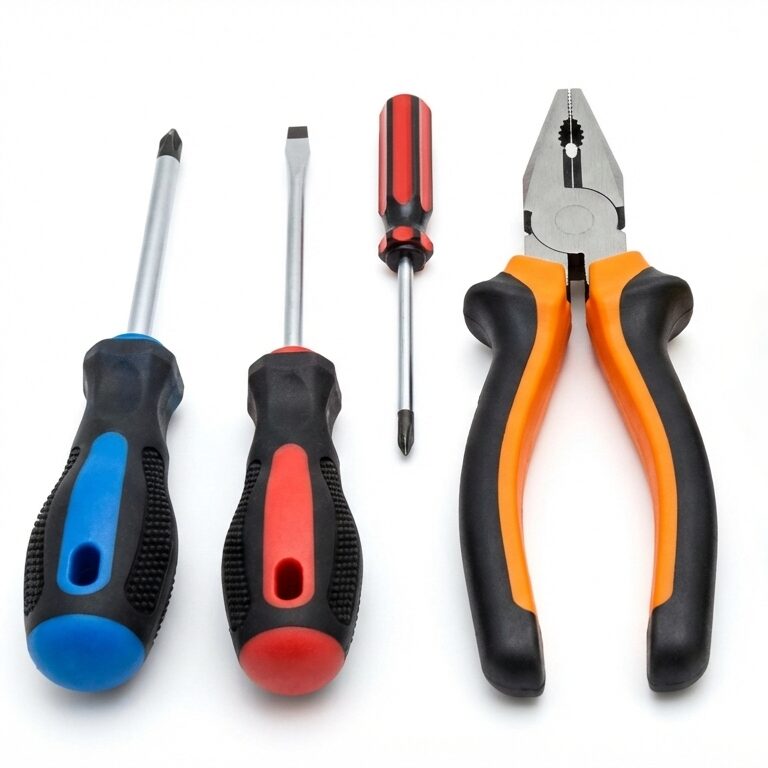
Hand Tool Handles
Metal Inserts: Steel screwdriver shafts, plier bodies, power transmission spindles, ratchet mechanism components, and metal sleeves.
Plastic Components: PP / ABS / PA (Nylon) for the rigid structural frame; TPE for the soft overmolded grip.
Process: The metal frame is placed in the mold first. The first “shot” creates the rigid structure, followed by a second “shot” of soft rubber (overmolding).
Nut / Threaded Inserts in Power Tool Housings
Inserts: Brass nuts, steel threaded sleeves.
Plastic Components: PP / ABS / PA.
Application: Housing screw-down points, gearbox mounting points, and motor mounts.
Advantages: Facilitates assembly, provides high clamping force, and offers excellent creep resistance.
Process: Nuts and other inserts are placed into the mold, and the housing is injection-molded as a single unit.
Power Tool Handles
Inserts: Steel skeletons, internal reinforcements.
Plastic Components: PP + 30% GF (Glass Fiber) / ABS for the rigid structure; TPE for the overmolded grip.
Application: Commonly used to reinforce the handles of impact drills and angle grinders.
Process: The metal skeleton is pre-placed; multi-shot molding is used for the structure and soft-grip layers.
Power Tool Switch Components / Triggers
Inserts: Copper plates, leaf springs, conductive terminals.
Advantages: Achieves more precise positioning, reduces subsequent welding or assembly, and improves overall reliability.
Power Tool Gearbox Housings / Bearing Seats
Inserts: Steel sleeves, bearing outer races, positioning pins.
Application: Widely used in high-speed and impact-style power tools.
When Should You Use Insert Molding?
As an expert in tool OEM manufacturing, TIANTEC recommends prioritizing the insert molding process in the following scenarios:
- Frequent Disassembly: When the product requires screw fasteners for easy assembly, maintenance, or repair.
- Heavy Mechanical Stress: When the part is subjected to high torque, tension, or impact loads.
- Electrical Requirements: For components involving conductivity, grounding, or fixed electrical terminals.
- Ergonomics: When a specific “soft-touch” or overmolded grip is required.
- Tight Tolerances: When the application is highly sensitive to assembly position tolerances.