
How to Choose the Right Overmolding Injection Molding Factory for Tool Handles?
Key Insights: High-Quality Mold Design and OEM Processing for Overmolded Handles
Overmolded handles are widely used in hand tools and power tools. The process involves first injection molding a rigid skeleton (substrate), followed by a secondary injection of a soft elastomeric material (overmold) to create a composite handle with a “rigid structure + soft grip” configuration. These parts must provide structural support while ensuring ergonomic comfort, durability, and anti-slip properties. While not the most complex task in the industry, overmolded parts demand much higher precision than 70% of standard injection-molded components. With over 20 years of experience and a portfolio of 450+ handle mold projects, TIANTEC can confidently state that the mold development and contract manufacturing of these Functional Overmolding Parts require meticulous attention to detail.
Structure and Mechanical Performance of Overmolded Handles
An overmolded handle is far more than an aesthetic component; it is a critical load-bearing structural part. In tool applications, the overmold must actively participate in force transmission. Therefore, technical requirements for tensile strength, torsional resistance, and peel resistance are non-negotiable.
- Tensile Strength: Resistance to axial force—preventing the overmold from being pulled off toward the tail of the handle.
- Torsional Resistance: Resistance to rotational force (torque) around the central axis, generated during fastening or loosening tasks.
- Peel Resistance: Resistance to “edge lifting” or delamination, similar to peeling tape away from a surface.
BUT How do we optimize these properties? At TIANTEC, we enhance axial force through optimized interlocking structures, increase circumferential force by adjusting geometry and material hardness, and maximize peel resistance through precision detailing and material selection.
| Load Type | Typical Failure Mode | Key Design Considerations (Structure) | Key Process Considerations (Injection Molding) | Common Mistakes |
|---|---|---|---|---|
| Tensile Resistance(Axial Pull-off) | Overmold slides off axially“Sleeve-type” pull-off failure | 1. Circumferential undercuts 2. Through-holes for mechanical interlocking 3. End-wrap / return-over design 4. Multiple locking features instead of single-point retention | 1. Adequate substrate surface temperature during second shot 2. Avoid excessive cooling of first shot prior to overmolding 3. Overmold thickness ≥ 1.2 mm | 1. Relying solely on material adhesion 2. Undercuts too sha llow 3. Overmold layer too thin |
| Torque Resistance(Torsional Load) | Overmold slips relative to substrateLoss of torque transmission (“soft” feeling) | 1. Non-circular cross-section (polygonal profile) 2. Longitudinal ribs / splines 3. Wavy or toothed interface surfaces 4. Thinner overmold in high-torque zones | 1. Overmold hardness matched to torque requirements 2. Excessive injection speed may cause shear failure at interface 3. Insufficient packing pressure leads to voids and weak bonding | 1. Overmold too soft 2. Fully circular cross-section • Design only resists pull-off but not torsion |
| Peel Resistance(Edge Delamination) | Edge lifting and local delaminationProgressive peeling after initiation | 1. Edge wrap-around with radiused transitions 2. Dovetail or reverse-lock edge geometry 3. Avoid sharp termination edges 4. Gradual overmold thickness transition | 1. Proper venting to prevent edge burning 2. Stable mold temperature at edge areas 3. Use materials with proven aging resistance | • Cut-off type edge termination • Edge Overmold too thin • Aging performance not validated |
Learn more about our capabilities in injection molding: Plastic Injection Molding Services
Learn more about our capabilities in mold manufacturing: Precision Mold Development
Material Compatibility Requirements for Overmolding of Overmolded Handles
In overmolding and two-shot injection molding, the compatibility between the rigid substrate and the soft overmold is paramount. Common material combinations include:
| Rigid Substrate | Overmold Material (Soft) |
|---|---|
| PP | TPE (PP-based) |
| ABS | TPE / TPU |
| PA6 / PA66 | TPU |
| PC / PC+ABS | TPU / TPE |
Technical Note: To ensure superior mechanical performance, we prioritize polarity matching and select materials with overlapping melt temperature windows. We strongly recommend chemical bonding systems whenever possible to prevent delamination.
Ergonomics and Tactile Requirements (Hand-feel) of Overmolded Handles
The handle is the primary interface between the tool and the user. While a designer’s texture/graining design is the starting point, the actual “hand-feel” is achieved through precision mold making and process control. In the tool industry, this is defined as “Reproducible Ergonomic Experience.”
Mold Requirements for Surface Texturing
| Item | Mold Requirements |
|---|---|
| Texture Depth | Must be precisely controlled (deeper is not necessarily better) |
| Texture Uniformity | Seamless texture continuity across both sides of the parting line |
| EDM / Chemical Etching Process | Stable, repeatable, and highly reproducible |
| Mold Cavity Surface Quality | Free of machining marks and uneven or inconsistent polishing |
The surface must be slip-resistant without being abrasive. It must maintain friction even when exposed to sweat or oil, appearing visually uniform without “tiger stripes” or mottling.
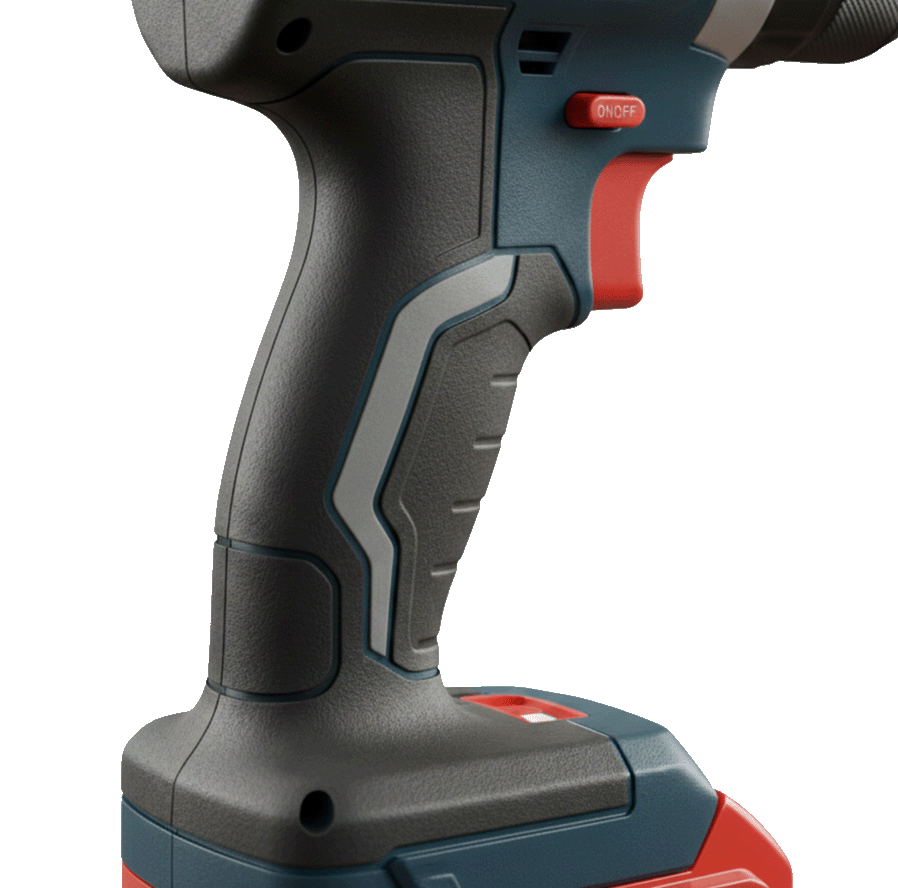
Parting Line (PL) Position and Height Control
The location of the parting line directly affects tactile comfort. Our designs avoid primary pressure points and the “web of the hand” (purlicue). We strictly control the stepping height to be less than 0.05 mm.
Overmold Thickness and Transition Design
The thickness of the overmolded layer directly determines the uniformity of softness and hardness during gripping. Mold design must ensure an even and well-controlled overmold thickness distribution to prevent localized thin areas that can cause a hard feel or tearing, as well as overly thick sections that may lead to sink marks and a spongy or unstable feel.
Thickness transitions should be designed with smooth, gradual tapers and appropriate fillet radii, eliminating hard spots and stress concentrations. This ensures a continuous, consistent tactile feel across the entire grip surface while improving durability and perceived quality.
Impact of Venting Design on Surface Tactile Quality
The quality of venting in overmolded areas has a direct impact on the final surface condition. Insufficient venting can lead to defects such as burn marks, surface pitting, or abnormal gloss. Even when these issues are not visually obvious, they are often amplified through touch and negatively affect the perceived hand feel.
The mold must incorporate effective micro-venting features at the flow end of the overmolded section and in air-trap–prone areas. Proper venting ensures complete material filling, stable process conditions, and a fine, uniform surface texture with a high-quality tactile feel.
Material Condition Control and Tactile Consistency
The processing condition of overmolding materials is fundamental to achieving a stable tactile feel that is non-sticky, non-slippery, and resistant to dust attraction. During injection molding, melt temperature, shear rate, and drying conditions must be tightly controlled to prevent tactile degradation caused by overheating, material degradation, or abnormal moisture content.
Even with the same material grade, variations in the processing window can result in significant differences in surface feel. Therefore, consistent process control is critical to maintaining uniform hand feel and reliable product quality in overmolded components.
Mold Temperature Requirements for Texture Replication
The effectiveness of anti-slip textures depends on whether they are fully and accurately replicated on the part surface. If the mold temperature is too low, fine texture details may not be properly formed, resulting in a surface that appears textured but provides insufficient grip in actual use.
A stable and appropriately controlled mold temperature is a prerequisite for consistent texture replication. It is also a critical process parameter for ensuring uniform tactile performance and grip feel across mass production.
Effect of Injection Speed and Holding Pressure on Grip Feel
Injection speed and holding pressure directly influence the microstructure of the overmolded surface. Excessively high injection speed may wash out or flatten surface textures, while overly low speed can lead to uneven surface frosting or inconsistent appearance. Insufficient holding pressure can result in a hollow or soft surface feel, whereas excessive holding pressure may cause the surface to become overly glossy and hard.
Grip comfort is not determined by a single process parameter, but by the optimized balance between injection speed and holding pressure within a stable processing window.
So, What Defines a High-Quality Overmolded Injection Handle?
The hallmark of a good overmolded handle isn’t just that it’s ‘soft,’ but that it: won’t pull off, won’t twist/slip, won’t break when dropped, won’t get sticky over time, and won’t tire you out.
At TIANTEC, we apply a comprehensive, system-level optimization approach built on over 20 years of hands-on experience in injection molding and overmolding technology. From material selection and mold design to process window control and mass-production consistency, we deliver overmolded handles that perform reliably across every critical dimension.
View more examples of our injection-molded part: Plastic Products and Project Cases | TIANTEC
For in-depth technical discussions, feasibility analysis for specific projects, or OEM/ODM overmolded handle manufacturing, please feel free to contact us directly. We are ready to support your project with proven expertise and engineering-driven solutions.

